
Post
Best Graphics Card for Video Editing in 2026: Top GPUs for Premiere Pro, DaVinci Resolve & Blender
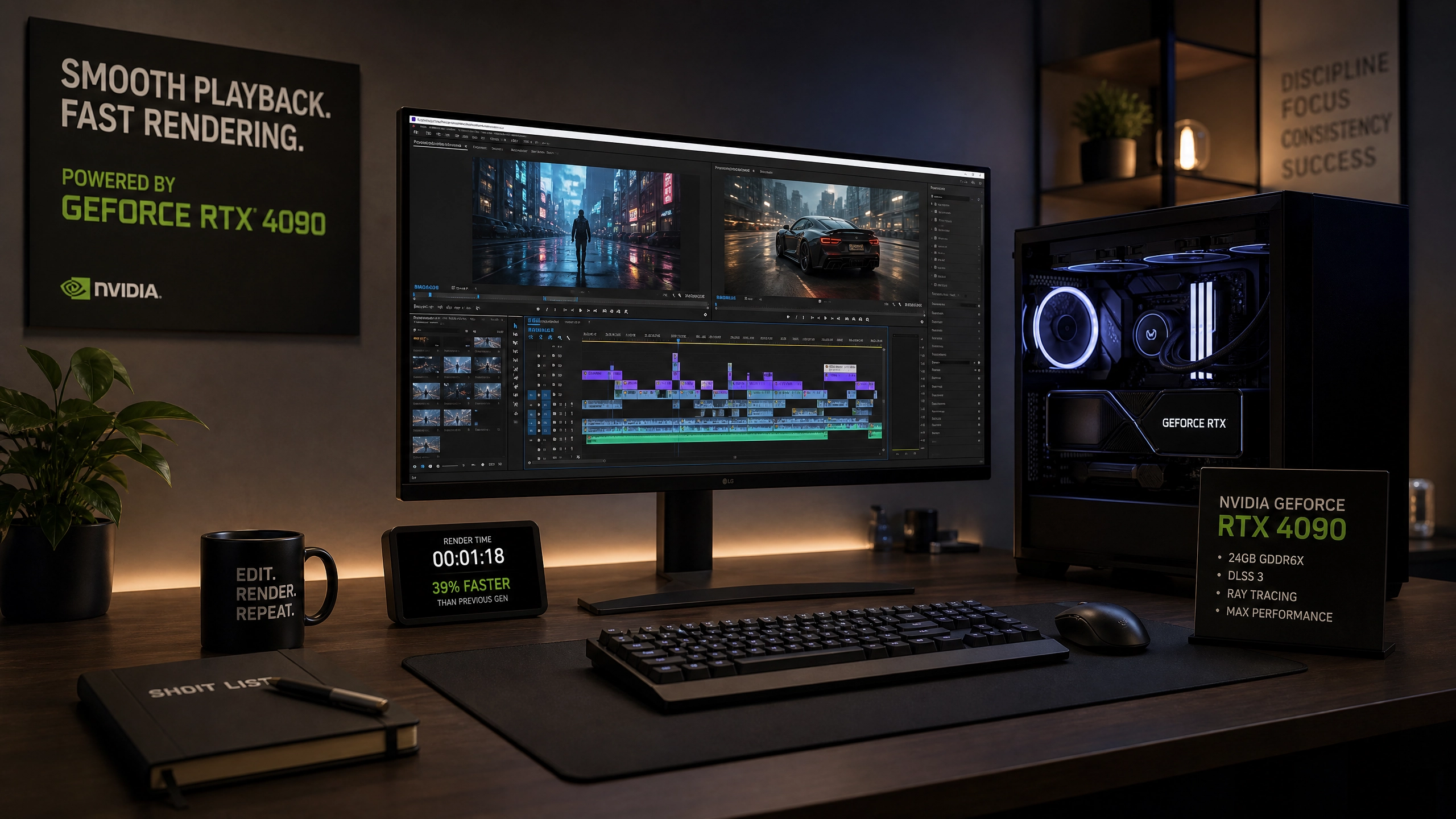
May
Best Graphics Card for Video Editing and 3D Rendering in 2026
Choosing the best graphics card for video editing has become one of the most important decisions for content creators, video editors, 3D artists, and professional workstation users. Modern creative software relies heavily on GPU acceleration to process high-resolution footage, real-time effects, AI tools, and advanced rendering workloads.
Whether you work with Adobe Premiere Pro, DaVinci Resolve, Blender, After Effects, or Cinema 4D, selecting the right GPU can dramatically improve rendering speed, playback smoothness, and workflow efficiency.
In this complete guide, we explore how to choose the best GPU for professional content creation while balancing performance, VRAM capacity, thermals, and long-term value.
Why the Best Graphics Card for Video Editing Matters
Modern graphics cards are no longer limited to gaming. Today’s GPUs function as advanced parallel processing engines capable of accelerating demanding production tasks such as:
4K and 8K video editing
Color grading
Motion graphics
AI-assisted rendering
Real-time playback
3D rendering
GPU encoding and decoding
Applications like Premiere Pro and DaVinci Resolve heavily utilize GPU acceleration to reduce export times and improve timeline responsiveness. A powerful GPU allows creators to work with high-bitrate footage, complex effects, and large projects without frustrating lag or dropped frames.
Key Features to Look for in a Video Editing GPU
1. VRAM Capacity
Video memory is critical for professional workloads. Higher resolutions and advanced visual effects require substantial VRAM.
Recommended VRAM levels:
8GB VRAM → Entry-level 1080p editing
12GB VRAM → Ideal for 4K workflows
16GB+ VRAM → Professional 6K/8K editing and 3D rendering
For Blender and advanced rendering pipelines, large VRAM buffers help prevent memory bottlenecks during scene processing. best graphics card for video editing
GPU Performance and Rendering Speed
Raw GPU power directly affects rendering performance. Important factors include:
CUDA cores or Stream Processors
Memory bandwidth
Tensor and AI acceleration
Ray tracing hardware
GPU clock speeds
High-end GPUs dramatically reduce export times in Premiere Pro and improve viewport responsiveness in Blender.
Creators working with complex timelines, RAW footage, or multi-camera projects benefit significantly from faster GPUs.
NVIDIA vs AMD for Video Editing
NVIDIA GPUs
NVIDIA remains the dominant choice for professional creators due to:
CUDA acceleration
Excellent driver stability
- best graphics card for video editing
Broad software compatibility
Superior AI rendering support
NVENC hardware encoding
Programs like Blender, OctaneRender, and many AI applications are optimized heavily for CUDA-based workflows.
AMD GPUs
AMD offers strong value and competitive rasterization performance. Advantages include:
Better price-to-performance ratios
Large VRAM capacities
Open-source ecosystem support
Strong DaVinci Resolve optimization
AMD GPUs continue improving in creative workloads, especially for editors prioritizing value.
Best GPUs for Premiere Pro and DaVinci Resolve
Adobe Premiere Pro
Premiere Pro benefits from:
CUDA acceleration
Hardware encoding
AI-assisted features
Fast timeline rendering
NVIDIA RTX GPUs typically perform exceptionally well due to optimized Adobe support.
DaVinci Resolve
DaVinci Resolve relies heavily on GPU acceleration for:
Color grading
Fusion effects
Noise reduction
AI processing
Resolve scales extremely well with powerful GPUs and large VRAM capacities.
Best Graphics Card for Blender and 3D Rendering
Blender users should prioritize:
CUDA or OptiX acceleration
Large VRAM buffers
Strong ray tracing performance
Stable drivers
3D rendering workloads benefit enormously from modern GPUs because rendering engines utilize thousands of parallel cores simultaneously. best graphics card for video editing
Professional artists working with large scenes, particle systems, and advanced lighting setups should consider GPUs with 16GB VRAM or more. best graphics card for video editing
Thermal Performance and Power Consumption
High-performance GPUs generate substantial heat under sustained rendering loads. Proper cooling is essential for maintaining stable performance.
Important considerations include:
Triple-fan cooling systems
Vapor chamber cooling
Efficient airflow
PSU wattage requirements
Thermal pad quality
Pairing your GPU with a reliable power supply ensures system stability during heavy rendering sessions. best graphics card for video editing
Future-Proofing Your GPU Investment
Creative software evolves rapidly. Future-proofing requires choosing hardware capable of handling:
AI-enhanced workflows
Higher-resolution codecs
Advanced rendering engines
Real-time ray tracing
GPU-intensive effects
Investing in a modern GPU with ample VRAM and support for DirectX 12 Ultimate and Vulkan ensures longer hardware lifespan and better software compatibility. best graphics card for video editing
Frequently Asked Questions
What is the best graphics card for video editing?
The best GPU depends on your workflow, software, and budget. NVIDIA RTX GPUs are excellent for Premiere Pro and Blender, while AMD GPUs offer strong value for DaVinci Resolve users. best graphics card for video editing
How much VRAM do I need for video editing?
8GB → Basic editing
12GB → 4K workflows
16GB+ → Professional 8K and 3D rendering
Is GPU more important than CPU for video editing?
Both matter. The CPU handles decoding and system operations, while the GPU accelerates effects, rendering, and playback.
Balanced hardware delivers the best performance.
Are gaming GPUs good for professional editing?
Yes. Modern gaming GPUs offer excellent performance for creative applications and are widely used by professional creators.
Should I choose NVIDIA or AMD?
Choose NVIDIA for maximum software compatibility and AI acceleration. Choose AMD for strong value and large VRAM capacities at competitive prices.
Final Thoughts
Finding the best graphics card for video editing requires balancing GPU performance, VRAM capacity, thermals, software support, and future-proofing.
For creators working in Premiere Pro, DaVinci Resolve, Blender, and After Effects, investing in the right GPU dramatically improves productivity and workflow efficiency. Modern GPUs accelerate rendering, reduce export times, and enable smooth real-time editing experiences even with demanding 4K and 8K projects.
As creative workloads continue evolving toward AI-enhanced production pipelines, choosing a powerful and efficient graphics card becomes increasingly important for long-term workstation performance. link.site
