Post
GDDR6 vs GDDR7: What’s the Difference and Should You Upgrade in 2026?
May
GDDR6 vs GDDR7: What’s the Difference and Should You Upgrade in 2026?
The discussion around GDDR6 vs GDDR7 has become one of the hottest topics in the GPU industry as modern graphics cards continue pushing the limits of gaming, AI acceleration, and high-resolution rendering. Graphics memory plays a critical role in determining how quickly a GPU can process textures, frame buffers, ray tracing calculations, and AI-enhanced rendering workloads.
As games become more demanding and visual technologies continue evolving, understanding GDDR6 vs GDDR7 is increasingly important for gamers, creators, and PC enthusiasts looking to build future-proof systems. Modern AAA titles now rely heavily on massive texture assets, advanced ray tracing pipelines, and AI-assisted upscaling technologies that place enormous pressure on GPU memory bandwidth.
In this complete guide, we will explain the key differences between GDDR6 and GDDR7 memory, compare performance improvements, analyze gaming impacts, and help you decide whether upgrading to GDDR7-based graphics cards is worth it in 2026.
What Is GDDR Memory?
Before understanding GDDR6 vs GDDR7, it is important to understand what GDDR memory actually does.
GDDR stands for Graphics Double Data Rate memory. It is specialized high-speed memory designed specifically for graphics processing units.
Unlike standard system RAM, GDDR memory is optimized for:
- Massive bandwidth
- Parallel processing
- Low-latency texture streaming
- High-resolution rendering
- AI acceleration
- Ray tracing workloads
Modern GPUs from NVIDIA and AMD rely heavily on ultra-fast memory systems to feed enormous amounts of data into the GPU cores.
Without sufficient memory bandwidth, even the most powerful GPU cores become bottlenecked.
What Is GDDR6?
GDDR6 became the standard graphics memory technology for modern gaming GPUs throughout the late 2010s and early 2020s.
GDDR6 introduced major improvements over older GDDR5 memory, including:
- Higher bandwidth
- Better efficiency
- Faster transfer rates
- Improved thermal performance
- Lower power consumption
Most modern GPUs released before the transition to GDDR7 use GDDR6 or GDDR6X memory.
Typical GDDR6 speeds include:
- 14Gbps
- 16Gbps
- 18Gbps
- 20Gbps
GDDR6 helped power high-end gaming experiences involving:
- 1440p gaming
- 4K gaming
- Ray tracing
- AI upscaling
- High-refresh-rate displays
For years, GDDR6 represented the ideal balance between speed, cost, and power efficiency.
What Is GDDR7?
GDDR7 is the next-generation graphics memory standard designed to dramatically increase memory bandwidth and efficiency.
The biggest improvements in GDDR6 vs GDDR7 involve:
- Much higher bandwidth
- Lower latency
- Better efficiency
- Improved signaling technology
- Higher transfer rates
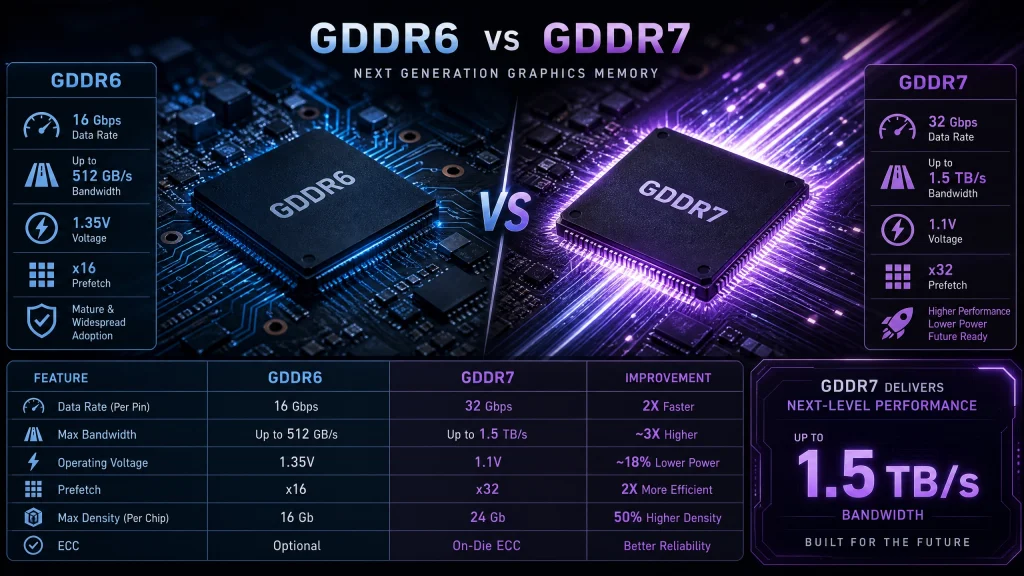
GDDR7 introduces PAM3 signaling technology, allowing more data to be transferred per clock cycle compared to traditional signaling methods used by GDDR6.
This enables significantly faster memory performance without requiring excessively high clock frequencies.
Early GDDR7 implementations can exceed:
- 28Gbps
- 32Gbps
- 36Gbps+
This creates massive improvements in total memory bandwidth.
GDDR6 vs GDDR7 Bandwidth Comparison
Bandwidth is one of the most important factors in GDDR6 vs GDDR7 comparisons.
Memory bandwidth determines how quickly the GPU can access and transfer data between GPU cores and VRAM.
GDDR6 Bandwidth
Typical GDDR6 GPUs offer bandwidth ranging from:
- 448 GB/s
- 576 GB/s
- 800 GB/s
depending on memory speed and bus width.
GDDR7 Bandwidth
GDDR7 dramatically increases total bandwidth potential.
High-end GPUs using GDDR7 may exceed:
- 1TB/s memory bandwidth
This is especially important for:
- 4K gaming
- 8K rendering
- Ray tracing
- AI workloads
- Large texture streaming
When discussing GDDR6 vs GDDR7, bandwidth improvements are among the biggest generational upgrades.
GDDR6 vs GDDR7 Gaming Performance
Gaming performance is where many users first notice the differences between GDDR6 vs GDDR7.
GDDR6 Gaming Experience
GDDR6 still delivers excellent gaming performance for:
- 1080p gaming
- 1440p gaming
- Many 4K workloads
Modern GPUs using GDDR6 remain highly capable for most current games.
GDDR7 Gaming Improvements
GDDR7 becomes especially valuable in scenarios involving:
- Ultra-resolution textures
- Heavy ray tracing
- Path tracing
- AI frame generation
- Large open-world environments
Modern games like:
- Cyberpunk 2077
- Black Myth: Wukong
- Alan Wake 2
- The Witcher 4
can place enormous stress on memory systems.
The increased bandwidth of GDDR7 helps reduce bottlenecks and improve frame consistency during demanding rendering workloads.
Ray Tracing and AI Workloads
Ray tracing is one of the biggest reasons GDDR7 matters.
When comparing GDDR6 vs GDDR7, newer memory standards help accelerate:
- Lighting calculations
- Reflection data
- AI reconstruction
- Ray traversal pipelines
- Geometry streaming
Modern AI rendering technologies such as DLSS and frame generation also consume additional memory bandwidth.
As GPU architectures become increasingly AI-focused, faster memory systems become essential.
Power Efficiency and Thermal Improvements
Efficiency is another major area of improvement in GDDR6 vs GDDR7.
Although GDDR7 delivers dramatically higher bandwidth, it also improves:
- Power efficiency
- Signal integrity
- Thermal management
Modern GPUs already consume substantial power, making memory efficiency extremely important.
Better memory efficiency helps:
- Reduce heat output
- Improve laptop battery life
- Maintain stable clock speeds
- Lower cooling requirements
This is especially important for compact gaming laptops and small-form-factor PCs.
GDDR6 vs GDDR7 for Content Creation
Creators and professionals benefit significantly from higher memory bandwidth.
Applications such as:
- Adobe Premiere Pro
- DaVinci Resolve
- Blender
can take advantage of faster memory systems during:
- 4K video editing
- 8K rendering
- AI-assisted effects
- GPU rendering
- Real-time playback
For professional workloads, GDDR7 provides stronger long-term scalability.
Should You Upgrade to GDDR7?
The answer depends on your workload and current hardware.
Upgrade to GDDR7 If You Want:
- Maximum future-proofing
- 4K or 8K gaming
- Heavy ray tracing
- AI rendering acceleration
- Professional creative workloads
- Long-term GPU longevity
Stay with GDDR6 If:
- You mainly play esports titles
- You game at 1080p
- Your current GPU performs well
- Budget is your main concern
Modern GDDR6 GPUs still provide excellent gaming experiences for many users.
Future-Proofing and the Future of GPU Memory
The transition from GDDR6 to GDDR7 represents a major step forward in graphics memory technology.
As games continue evolving toward:
- Path tracing
- AI-assisted rendering
- Massive open worlds
- Ultra-resolution textures
- Real-time cinematic lighting
memory bandwidth requirements will continue increasing rapidly.
Understanding GDDR6 vs GDDR7 helps buyers make smarter long-term purchasing decisions when investing in expensive graphics hardware.
Frequently Asked Questions
Is GDDR7 faster than GDDR6?
Yes. GDDR7 offers dramatically higher memory bandwidth and transfer speeds compared to GDDR6.
Does GDDR7 improve gaming performance?
Yes, especially in demanding workloads involving ray tracing, 4K gaming, and AI-enhanced rendering.
Is GDDR6 still good in 2026?
Absolutely. GDDR6 still delivers excellent performance for most modern games and workloads.
Should I upgrade from GDDR6 to GDDR7?
If you want maximum future-proofing, heavy ray tracing, or professional creative performance, GDDR7 is a strong upgrade.
Why does memory bandwidth matter?
Memory bandwidth determines how quickly the GPU can access textures, rendering data, and AI workloads without bottlenecks.
Final Thoughts
The debate surrounding GDDR6 vs GDDR7 highlights the growing importance of memory bandwidth in modern GPU design. As gaming, AI rendering, and content creation workloads continue becoming more demanding, faster graphics memory standards are essential for maintaining smooth performance and long-term scalability.
GDDR6 remains highly capable for most gamers in 2026, especially at 1080p and 1440p resolutions. However, GDDR7 introduces substantial improvements in bandwidth, efficiency, and future-proofing that will become increasingly valuable as next-generation games push hardware requirements even further.
For enthusiasts building premium gaming systems or professional workstations, understanding the differences between GDDR6 vs GDDR7 can help ensure smarter purchasing decisions and longer-lasting GPU investments. link.site