Post
When Should You Upgrade Your Graphics Card? The Ultimate 2026 Guide
May
When to Upgrade Graphics Card in 2026: Complete GPU Upgrade Guide
Knowing when to upgrade graphics card hardware has become increasingly important as modern games, creative applications, and AI-driven technologies continue demanding more graphical power every year. Whether you are a gamer chasing higher frame rates, a creator working with 4K video, or a professional running GPU-accelerated workloads, upgrading at the right time can dramatically improve your overall PC experience.
Many users struggle with the decision of when to upgrade graphics card components because GPU prices remain high and new hardware generations launch frequently. Some gamers upgrade too early and waste money, while others wait too long and suffer poor performance, stuttering, and compatibility problems with newer software.
In this complete guide, we will explain exactly when to upgrade graphics card hardware, the biggest warning signs your GPU is becoming outdated, how modern games impact GPU longevity, and how to maximize long-term value from your next upgrade.
Why Graphics Cards Matter More Than Ever
Modern graphics cards are no longer used only for gaming. GPUs now accelerate:
- 3D rendering
- Video editing
- AI workloads
- Machine learning
- Streaming
- Simulation software
- Ray tracing
- Real-time effects
Companies like NVIDIA and AMD continue pushing GPU technology forward with increasingly advanced architectures and AI-assisted rendering systems.
Because software is evolving so quickly, understanding when to upgrade graphics card hardware has become critical for maintaining smooth system performance.
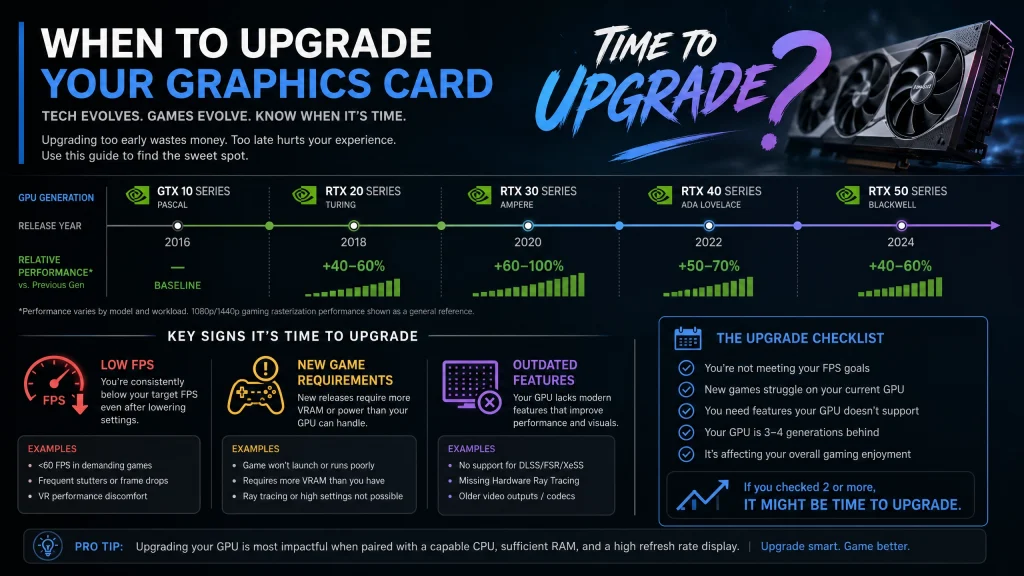
The Biggest Signs It Is Time to Upgrade Your Graphics Card
One of the most important parts of deciding when to upgrade graphics card hardware is identifying the warning signs of an aging GPU.
1. Low Frame Rates in Modern Games
If your games no longer maintain stable FPS at your preferred settings, it may be time for an upgrade.
Common symptoms include:
- FPS drops
- Stuttering
- Frame pacing issues
- Input lag
- Texture pop-in
Modern AAA games such as:
- Cyberpunk 2077
- Black Myth: Wukong
- Starfield
- The Witcher 4
place enormous pressure on older GPUs.
If you constantly lower settings just to maintain playable performance, it is likely time to evaluate when to upgrade graphics card hardware.
2. Your GPU Lacks Enough VRAM
VRAM limitations are one of the biggest reasons people upgrade GPUs in 2026.
Modern games increasingly require:
- High-resolution textures
- Ray tracing buffers
- AI rendering assets
- Larger open-world environments
If your GPU runs out of VRAM, you may experience:
- Severe stuttering
- Texture streaming issues
- Reduced FPS
- Crashes
- Poor frame consistency
For many modern games:
- 8GB VRAM is now considered the minimum
- 12GB VRAM is recommended
- 16GB+ VRAM offers better future-proofing
Understanding VRAM usage is a key part of deciding when to upgrade graphics card hardware.
3. Your GPU Cannot Support Modern Features
Another major factor in when to upgrade graphics card decisions is feature support.
Modern technologies include:
- Ray tracing
- AI frame generation
- DLSS
- FSR
- AV1 encoding
- DirectX 12 Ultimate
- Vulkan optimization
Older GPUs may completely lack support for these features.
Without modern hardware acceleration, newer games and applications may run poorly or miss advanced visual effects entirely.
4. You Upgraded Your Monitor Resolution
Higher monitor resolutions require dramatically more GPU power.
If you recently upgraded to:
- 1440p
- Ultrawide
- 4K
- High refresh rate displays
your old GPU may struggle to keep up.
Many users realize when to upgrade graphics card hardware only after upgrading their display and noticing major performance drops.
Higher resolutions require:
- More VRAM
- More memory bandwidth
- Stronger GPU cores
- Better cooling performance
5. Your GPU Is Becoming Too Loud or Too Hot
Thermal issues can indicate aging hardware.
Signs include:
- Loud fan noise
- High temperatures
- Thermal throttling
- Random shutdowns
- Reduced boost clocks
Modern GPUs generate substantial heat, especially during long gaming sessions.
Older cooling systems may degrade over time due to:
- Dust buildup
- Fan wear
- Thermal paste aging
Monitoring software can help determine whether thermals are limiting performance.
When to Upgrade Graphics Card for Gaming
Gaming remains the biggest reason people upgrade GPUs.
Upgrade Immediately If:
- You cannot maintain 60 FPS
- Modern games require ultra-low settings
- VRAM limitations cause stuttering
- Ray tracing is unusable
- Your GPU lacks modern feature support
You Can Wait If:
- Games still run smoothly
- Your GPU supports modern APIs
- Temperatures remain stable
- Your target resolution performs well
For gamers, understanding when to upgrade graphics card hardware depends heavily on personal expectations and target performance.
When to Upgrade Graphics Card for Content Creation
Creators often need GPU upgrades sooner than gamers.
Applications such as:
- Adobe Premiere Pro
- DaVinci Resolve
- Blender
rely heavily on GPU acceleration.
You should consider upgrading if:
- Rendering takes too long
- Timeline playback stutters
- VRAM becomes overloaded
- AI tools perform poorly
- GPU encoding lacks support
Modern creative workflows increasingly depend on large VRAM buffers and AI acceleration hardware.
How Long Should a Graphics Card Last?
Many people researching when to upgrade graphics card hardware wonder how long GPUs should remain useful.
Typical GPU lifespan:
- Entry-level GPUs → 3 to 4 years
- Mid-range GPUs → 4 to 6 years
- High-end GPUs → 5 to 7 years
Actual longevity depends on:
- Gaming resolution
- VRAM capacity
- Cooling quality
- Driver support
- Workload intensity
Higher-end GPUs generally age better because they start with more performance headroom.
Should You Wait for the Next GPU Generation?
This is one of the most common questions surrounding when to upgrade graphics card hardware.
The answer depends on timing.
Wait If:
- New GPUs launch within a few months
- Current pricing is inflated
- Your GPU still performs adequately
Upgrade Now If:
- Your workflow suffers daily
- Games perform poorly
- Your GPU lacks required features
- Hardware instability appears
Waiting indefinitely often leads to unnecessary frustration and reduced productivity.
Future-Proofing Your Next GPU Upgrade
Future-proofing is critical when investing in expensive graphics hardware.
When planning your next upgrade, prioritize:
- Larger VRAM capacity
- Modern AI acceleration
- Efficient cooling
- Strong ray tracing support
- AV1 encoding
- DirectX 12 Ultimate compatibility
GPUs with larger VRAM buffers and stronger AI hardware will likely age more gracefully throughout the rest of the decade.
Frequently Asked Questions
When should I upgrade my graphics card?
You should upgrade when modern games or applications no longer perform smoothly at your desired settings and resolution.
How many years does a GPU last?
Most GPUs remain useful for 4 to 6 years, depending on performance tier and workload demands.
Is 8GB VRAM enough in 2026?
8GB remains usable, but newer AAA games increasingly benefit from 12GB or more.
Should I upgrade my GPU or CPU first?
If gaming performance is limited by low FPS or graphical settings, upgrading the GPU usually provides the biggest improvement.
Can old GPUs still run modern games?
Yes, but many older GPUs require lower settings and may struggle with ray tracing or modern rendering technologies.
Final Thoughts
Understanding when to upgrade graphics card hardware is essential for maintaining a smooth, responsive, and future-ready PC experience. Modern games and creative applications continue demanding more GPU power, more VRAM, and stronger AI acceleration every year.
If your current GPU struggles with modern workloads, lacks sufficient VRAM, overheats frequently, or cannot support newer technologies like ray tracing and AI frame generation, it may be the ideal time to upgrade.
Making smart upgrade decisions ensures better gaming performance, faster creative workflows, lower system frustration, and stronger long-term value from your PC investment.link.site