
Post
Cloud Gaming vs Local GPU: Is PC Building Dead in 2026?
May
Cloud Gaming vs Local GPU: Is PC Building Dead in 2026?
SEO Title: Cloud Gaming vs Local GPU: Is PC Building Dead?
Focus Keyword: cloud gaming vs local GPU
SEO URL: /cloud-gaming-vs-local-gpu
Meta Description: Cloud gaming vs local GPU explained in detail. Compare GeForce NOW, gaming PCs, latency, FPS, streaming quality, costs, and whether PC building is still worth it in 2026.
Cloud Gaming vs Local GPU: Is PC Building Dead in 2026?
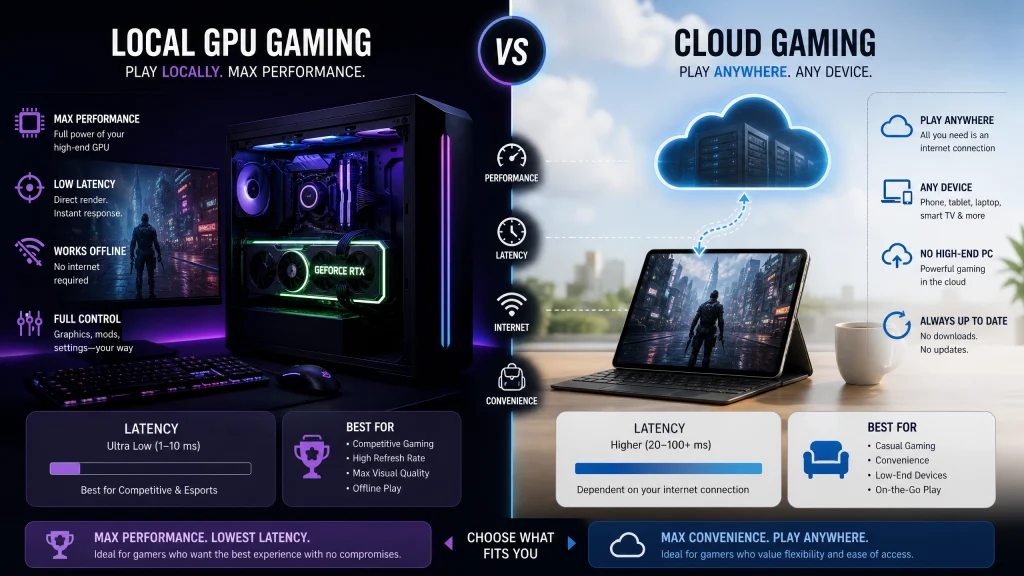
The debate around cloud gaming vs local GPU technology has become one of the biggest conversations in the gaming industry. With internet speeds improving rapidly and cloud gaming services becoming more powerful, many gamers are beginning to question whether building a traditional gaming PC is still worth the investment.
Platforms like NVIDIA GeForce NOW, Xbox Cloud Gaming, and PlayStation Cloud Streaming now allow users to play demanding AAA games without owning expensive graphics cards. At the same time, high-end GPUs continue becoming more expensive, making local PC gaming less accessible for many players.
So, does cloud gaming represent the future of gaming? Or will local GPU hardware continue dominating performance gaming for years to come?
In this detailed comparison, we will fully analyze cloud gaming vs local GPU performance, latency, graphics quality, cost efficiency, internet requirements, and future gaming trends to determine whether PC building is actually dying in 2026.
What Is Cloud Gaming?
Cloud gaming allows games to run on remote servers instead of your local hardware. The gameplay video is streamed to your device over the internet while your inputs are sent back to the server in real time.
Popular cloud gaming platforms include:
- NVIDIA GeForce NOW
- Xbox Cloud Gaming
- PlayStation Plus Cloud Streaming
- Amazon Luna
- Boosteroid
With cloud gaming, users can play modern AAA titles on:
- Laptops
- Smartphones
- Tablets
- Smart TVs
- Low-end PCs
without requiring powerful local GPUs.
What Is Local GPU Gaming?
Local GPU gaming means games are rendered directly on your own hardware using dedicated graphics cards.
Popular gaming GPUs include:
- NVIDIA GeForce RTX 5090
- NVIDIA GeForce RTX 5080
- AMD Radeon RX 8900 XTX
Local gaming systems provide:
- Native rendering
- Lower latency
- Full graphical control
- Offline gameplay
- Maximum FPS performance
For competitive gamers and enthusiasts, local GPU gaming still represents the gold standard.


Cloud Gaming vs Local GPU Performance
When discussing cloud gaming vs local GPU, performance remains the biggest difference.
Local GPU Advantages
Local gaming PCs deliver:
- Native 4K rendering
- Ultra-high FPS
- Better image quality
- Lower input latency
- Stable performance without internet dependency
Modern GPUs can push:
- 240Hz esports gaming
- Ray tracing
- DLSS AI upscaling
- VR gaming
- Ultra settings at 4K
Cloud Gaming Advantages
Cloud gaming offers:
- Instant hardware access
- No GPU upgrade costs
- Easy accessibility
- Cross-device compatibility
- Lower upfront expenses
Cloud gaming allows users with weak hardware to experience high-end gaming remotely.
Input Latency and Responsiveness
Latency is one of the most critical factors in the cloud gaming vs local GPU debate.
Local GPU Gaming
Local hardware provides extremely low latency because the game runs directly on the machine.
This is essential for:
- Competitive shooters
- Racing games
- Fighting games
- VR gaming
- Esports titles
Cloud Gaming Challenges
Cloud gaming introduces additional latency because:
- Inputs travel to remote servers
- The game renders remotely
- Video streams back to the player
Even with fast internet, cloud gaming still cannot fully match local hardware responsiveness.
Internet Requirements for Cloud Gaming
Cloud gaming depends heavily on internet quality.
Recommended internet speeds:
- 25 Mbps for 1080p gaming
- 50 Mbps+ for 4K streaming
- Low ping under 20ms
- Stable fiber connections
Poor internet connections can cause:
- Compression artifacts
- Input lag
- Stuttering
- Resolution drops
- Stream interruptions
Local GPU gaming avoids these problems entirely.
Graphics Quality Comparison
One major issue in cloud gaming vs local GPU comparisons is image quality.
Local GPU Quality
Local rendering provides:
- Native textures
- Sharper image clarity
- Higher bitrates
- Better color precision
- No streaming compression
Cloud Gaming Quality
Cloud gaming streams compressed video similar to YouTube or Netflix.
Although cloud streaming quality has improved dramatically, compression can still reduce:
- Texture sharpness
- Motion clarity
- Fine details
- Dark scene quality
Enthusiasts and content creators usually notice these differences immediately.


Cost Comparison: Cloud Gaming vs Local GPU
Cost is one reason cloud gaming continues growing rapidly.
Local GPU Costs
High-end gaming PCs are expensive:
- GPU prices continue rising
- Power supplies cost more
- Cooling systems add expense
- Monitors and peripherals increase budgets
A premium gaming PC can easily exceed several thousand dollars.
Cloud Gaming Costs
Cloud gaming usually requires:
- Monthly subscriptions
- Stable internet service
- Compatible controller or keyboard
For casual gamers, cloud gaming can be dramatically cheaper.
Is PC Building Still Worth It?
Despite cloud gaming growth, PC building remains extremely popular.
Reasons PC Building Survives
- Maximum gaming performance
- Hardware customization
- Upgrade flexibility
- Content creation capabilities
- Offline gaming reliability
- Modding support
Gaming PCs are not just gaming devices. They are also:
- Workstations
- Streaming systems
- Editing machines
- AI development platforms
Cloud gaming cannot fully replace these functions.
Cloud Gaming vs Local GPU for Competitive Gaming
Competitive gaming strongly favors local GPUs.
Professional esports players prioritize:
- Lowest possible latency
- Maximum frame rates
- Stable frametimes
- Precise responsiveness
Even small latency increases can affect reaction times in competitive environments.
Because of this, cloud gaming is unlikely to replace local esports systems anytime soon.
VR Gaming and Cloud Limitations
VR gaming places extremely high demands on latency and frame pacing.
Cloud streaming currently struggles with:
- VR motion latency
- Compression artifacts
- High refresh requirements
- Motion prediction accuracy
As a result, local GPUs remain essential for high-end VR gaming experiences.
Environmental and Energy Considerations
An interesting part of the cloud gaming vs local GPU debate involves energy efficiency.
Cloud Gaming Benefits
- Shared server infrastructure
- Reduced local power usage
- Lower hardware waste
Local GPU Challenges
- High power consumption
- Frequent hardware upgrades
- Increased electronic waste
However, massive cloud data centers also consume enormous amounts of electricity globally.
Future of Cloud Gaming
Cloud gaming technology continues improving rapidly thanks to:
- Faster fiber internet
- AI video compression
- Edge computing
- 5G networks
- Better server hardware
Future innovations may reduce latency significantly, making cloud gaming more competitive.
Still, internet infrastructure limitations remain a major challenge worldwide.
Who Should Choose Cloud Gaming?
Cloud gaming is ideal for:
- Casual gamers
- Budget users
- Travelers
- Players without gaming PCs
- Users with strong internet connections
It offers affordable access to modern gaming without massive upfront costs.
Who Should Choose Local GPU Hardware?
Local GPU gaming remains best for:
- Competitive gamers
- Enthusiasts
- Content creators
- VR players
- Streamers
- Modding communities
Local hardware still provides the best overall gaming experience.
Final Verdict on Cloud Gaming vs Local GPU
The battle between cloud gaming vs local GPU is reshaping the gaming industry, but PC building is far from dead.
Cloud gaming delivers impressive accessibility and affordability, making high-end gaming available to millions of players without expensive hardware investments. For casual gaming, it is becoming increasingly practical.
However, local GPU hardware still dominates in:
- Performance
- Latency
- Graphics quality
- VR gaming
- Competitive esports
- Content creation
For enthusiasts and serious gamers, building a gaming PC remains the superior experience in 2026.
Rather than replacing gaming PCs entirely, cloud gaming is more likely to coexist alongside traditional hardware, giving players multiple ways to access games depending on their budgets, internet quality, and performance expectations. link.site
