
Post
PCIe 4.0 vs 5.0 GPU: Does Upgrading Actually Improve FPS in 2026?
May
PCIe 4.0 vs 5.0 GPU: Does Upgrading Actually Improve FPS?
The debate surrounding PCIe 4.0 vs 5.0 GPU performance has become one of the hottest topics in the PC gaming community. With next-generation graphics cards becoming more powerful every year, many gamers wonder whether upgrading from PCIe 4.0 to PCIe 5.0 will actually improve FPS or simply increase build costs.
When building a high-performance gaming PC in 2026, understanding the differences between PCIe generations is extremely important. Modern GPUs deliver incredible rendering power, but bandwidth limitations, storage communication, and system architecture can still impact overall performance. The real question is whether PCIe 5.0 offers meaningful gaming benefits over PCIe 4.0.
In this guide, we will fully analyze PCIe 4.0 vs 5.0 GPU performance, compare real-world benchmarks, explain bandwidth differences, and determine whether upgrading is worth it for gamers, VR users, and creators.
What Is PCIe?
PCIe stands for Peripheral Component Interconnect Express. It is the high-speed interface used to connect graphics cards, SSDs, capture cards, and other expansion devices to the motherboard.
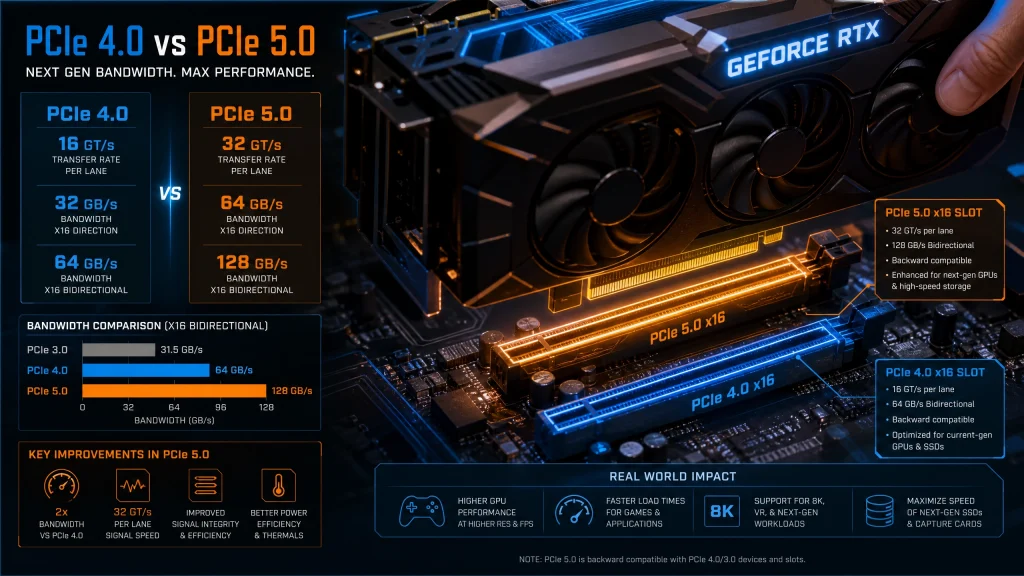
Each PCIe generation doubles bandwidth compared to the previous generation.
| PCIe Generation | Bandwidth Per Lane | x16 Total Bandwidth |
|---|---|---|
| PCIe 3.0 | 1 GB/s | 16 GB/s |
| PCIe 4.0 | 2 GB/s | 32 GB/s |
| PCIe 5.0 | 4 GB/s | 64 GB/s |
Theoretical bandwidth numbers look impressive, but real-world gaming performance tells a different story.
PCIe 4.0 vs 5.0 GPU Bandwidth Explained
The biggest difference in the PCIe 4.0 vs 5.0 GPU comparison is bandwidth. PCIe 5.0 doubles the communication speed between the GPU and motherboard.
However, modern graphics cards already contain ultra-fast onboard VRAM. Most rendering tasks occur directly inside the GPU without constantly relying on PCIe bandwidth.
That means even powerful GPUs often fail to fully saturate PCIe 4.0 x16 bandwidth during gaming.
For most modern games, the GPU depends more heavily on:
- Shader performance
- VRAM capacity
- GPU core architecture
- Ray tracing hardware
- CPU performance
PCIe bandwidth plays a smaller role than many users expect.


PCIe 4.0 vs 5.0 GPU Gaming Benchmarks
Real-world gaming benchmarks show surprisingly small FPS differences between PCIe 4.0 and PCIe 5.0 GPUs.
Testing with high-end graphics cards such as the NVIDIA GeForce RTX 5090 and AMD Radeon RX 8900 XTX reveals that gaming performance improvements are usually minimal.
Average Gaming Results
Most benchmark tests show:
- 0% to 2% FPS difference at 4K
- 1% to 3% difference at 1440p
- Almost no noticeable gameplay improvement
- Slightly faster asset streaming in some titles
Even with powerful GPUs, PCIe 5.0 rarely delivers major FPS gains because current games are not bandwidth-limited.
Why PCIe 5.0 Does Not Improve FPS Much
Understanding the reasons behind minimal FPS gains is essential when discussing PCIe 4.0 vs 5.0 GPU performance.
1. GPUs Use Onboard Memory
Modern GPUs store textures, shaders, and assets inside VRAM. Once loaded, most game data remains inside the graphics card itself.
2. PCIe 4.0 Is Already Extremely Fast
PCIe 4.0 x16 already provides massive bandwidth that exceeds the needs of most modern games.
3. GPU Compute Power Matters More
Core count, clock speed, AI accelerators, and ray tracing hardware impact FPS far more than PCIe bandwidth.
4. CPU Bottlenecks Are More Common
At lower resolutions, the processor often limits performance before PCIe bandwidth becomes relevant.
PCIe 4.0 vs 5.0 GPU for VR Gaming
Virtual reality gaming pushes hardware harder than traditional gaming because VR systems render two high-resolution images simultaneously.
Still, even in VR workloads, PCIe 4.0 vs 5.0 GPU differences remain relatively small.
The most important factors for VR gaming are:
- Stable frame rates
- Low latency
- Powerful GPU cores
- Sufficient VRAM
- Fast CPUs
PCIe 5.0 does not currently provide dramatic VR FPS improvements, although future ultra-high-resolution VR headsets may eventually benefit from additional bandwidth.
DirectStorage and Future Gaming Technologies
One area where PCIe 5.0 may become more important is DirectStorage.
DirectStorage allows NVMe SSDs to send data directly to the GPU, reducing CPU overhead and improving loading performance.
Future game engines with:
- Massive open worlds
- Real-time asset streaming
- Advanced ray tracing
- AI-generated textures
could eventually take better advantage of PCIe 5.0 bandwidth.
Right now, however, most games are still optimized around PCIe 4.0 hardware.


PCIe Lane Configurations Matter More
An important detail in the PCIe 4.0 vs 5.0 GPU discussion is lane configuration.
For example:
| Configuration | Total Bandwidth |
|---|---|
| PCIe 4.0 x16 | 32 GB/s |
| PCIe 5.0 x8 | 32 GB/s |
This means PCIe 5.0 x8 can provide similar bandwidth to PCIe 4.0 x16.
This becomes useful for:
- Compact PCs
- Mini-ITX builds
- Multi-GPU workstations
- High-speed storage expansion
PCIe 5.0 SSDs Benefit More Than GPUs
Currently, PCIe 5.0 SSDs benefit far more from the bandwidth upgrade than graphics cards.
Modern PCIe 5.0 NVMe drives can exceed 14 GB/s sequential read speeds, dramatically reducing:
- File transfer times
- Game loading screens
- Video editing workflows
- Large project exports
GPUs simply do not transfer data continuously enough to fully exploit PCIe 5.0 bandwidth yet.
Thermal and Power Considerations
PCIe 5.0 platforms may require:
- Better motherboard cooling
- Stronger VRMs
- Higher-quality PSUs
- Improved airflow
Fortunately, PCIe 5.0 GPUs themselves are not dramatically hotter purely because of the interface upgrade. GPU thermals still depend mostly on:
- Architecture efficiency
- Clock speeds
- Power consumption
- Cooling design
Should You Upgrade to PCIe 5.0?
Upgrade If:
- You are building a new premium PC
- You want long-term future-proofing
- You use creator or AI workloads
- You plan to keep your system for years
- You want PCIe 5.0 SSD support
Skip the Upgrade If:
- Your current gaming performance is already strong
- You mainly care about FPS gains
- You want better price-to-performance value
- Your GPU already runs on PCIe 4.0 x16
For gaming alone, upgrading solely for PCIe 5.0 GPU support is usually unnecessary.
The Future of PCIe Technology
The future of PCIe 4.0 vs 5.0 GPU technology will become more interesting as game engines evolve.
Future technologies may finally leverage PCIe 5.0 fully:
- AI-enhanced rendering
- Real-time world streaming
- Fully path-traced games
- Advanced VR ecosystems
- Cloud-assisted gaming
PCIe 6.0 is already under development, meaning bandwidth demands will continue growing rapidly.
Final Verdict on PCIe 4.0 vs 5.0 GPU
When comparing PCIe 4.0 vs 5.0 GPU performance today, the truth is simple: PCIe 5.0 rarely delivers major FPS improvements in current games.
Most modern GPUs do not fully saturate PCIe 4.0 x16 bandwidth, meaning gaming performance differences remain extremely small. In most cases, investing in a faster GPU, stronger CPU, or larger VRAM capacity provides far more noticeable gaming improvements.
However, PCIe 5.0 still offers advantages in:
- Future-proofing
- High-speed storage
- Professional workloads
- Multi-device systems
For gamers focused purely on FPS, PCIe 4.0 remains more than powerful enough in 2026. But for enthusiasts building long-term high-end systems, PCIe 5.0 represents an important investment for the future of PC gaming and next-generation computing. link.site
