
Post
Integrated vs Dedicated Graphics: Which GPU Option Is Best for Gaming, Work, and Everyday Use?
May
Integrated vs Dedicated Graphics: Which One Do You Need for Work and Play?
Understanding integrated vs dedicated graphics has become increasingly important as modern computers continue evolving toward more advanced gaming, content creation, and AI-powered workloads. Whether you are buying a new laptop, building a gaming PC, or upgrading an existing workstation, choosing between integrated graphics and dedicated graphics can significantly impact performance, power consumption, and long-term usability.
The debate surrounding integrated vs dedicated graphics is no longer limited to gamers. Today, students, professionals, creators, engineers, and casual users all need to understand how graphics hardware affects everyday computing tasks. From office productivity and streaming to 4K video editing and AAA gaming, the right graphics solution determines how smoothly your system performs under different workloads.
In this complete guide, we will break down the differences between integrated and dedicated graphics, compare their performance, explore real-world use cases, and help you decide which option is best for your needs in 2026.
What Are Integrated Graphics?
Integrated graphics are GPUs built directly into the CPU or motherboard chipset. Instead of having separate video memory, integrated graphics share system RAM with the processor.
Modern integrated graphics have improved dramatically over the last few years. Companies like Intel and AMD now produce processors with surprisingly capable integrated GPUs that can handle everyday computing tasks, media playback, and even light gaming.
Integrated graphics are commonly found in:
- Budget laptops
- Ultrabooks
- Office PCs
- Entry-level desktops
- Compact mini PCs
The biggest advantage of integrated graphics is efficiency. Systems using integrated GPUs typically consume less power, generate less heat, and offer longer battery life.
What Are Dedicated Graphics?
Dedicated graphics, also called discrete graphics cards, are separate hardware components specifically designed for rendering graphics and accelerating parallel computing workloads.
Unlike integrated solutions, dedicated GPUs include:
- Their own VRAM
- Independent cooling systems
- Specialized GPU cores
- Higher memory bandwidth
- Advanced rendering hardware
When comparing integrated vs dedicated graphics, dedicated GPUs provide significantly higher performance for demanding applications.
Dedicated graphics cards are manufactured primarily by NVIDIA and AMD.
These GPUs are commonly used in:
- Gaming PCs
- Video editing workstations
- 3D rendering systems
- AI and machine learning setups
- Engineering workstations
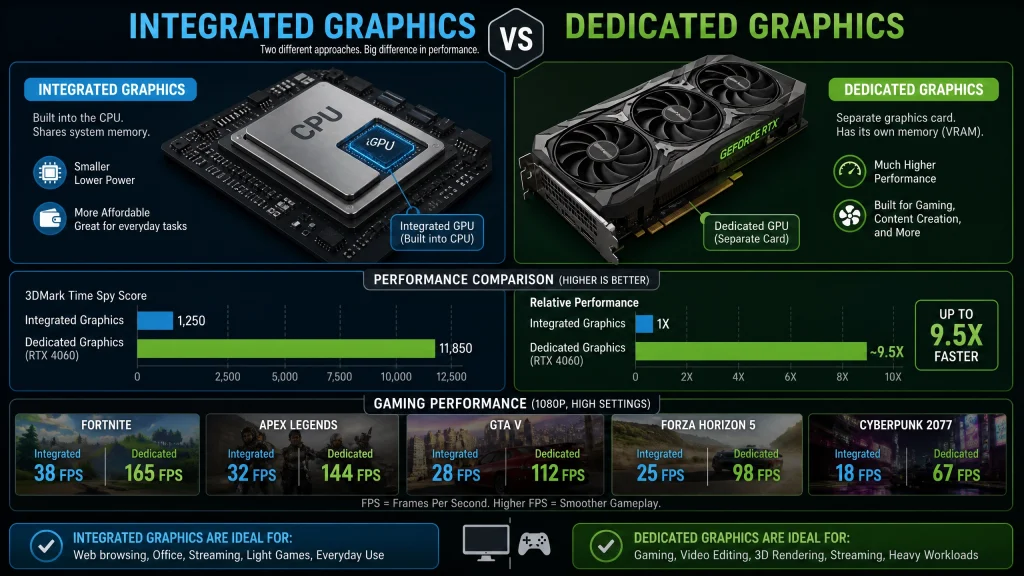
Integrated vs Dedicated Graphics: Performance Comparison
The biggest difference in integrated vs dedicated graphics is performance.
Integrated GPUs rely on shared system memory, which limits bandwidth and overall graphical capability. Dedicated GPUs include high-speed VRAM and significantly more processing power.
Integrated Graphics Performance
Modern integrated graphics can comfortably handle:
- Web browsing
- Office applications
- Streaming video
- Casual gaming
- Photo editing
- Light creative workloads
Some newer integrated GPUs can even run esports titles like:
- Valorant
- League of Legends
- Counter-Strike 2
at playable frame rates.
However, integrated GPUs struggle with demanding AAA games and professional rendering workloads.
Dedicated Graphics Performance
Dedicated GPUs are designed for high-performance workloads.
A dedicated GPU dramatically improves:
- Gaming frame rates
- Ray tracing performance
- Video rendering speed
- AI processing
- 3D modeling
- GPU acceleration
When discussing integrated vs dedicated graphics, dedicated GPUs dominate in workloads involving large textures, advanced lighting systems, and real-time rendering.
Games like:
- Cyberpunk 2077
- Black Myth: Wukong
- Starfield
- The Witcher 4
require dedicated graphics hardware for smooth gameplay at high settings.
Integrated vs Dedicated Graphics for Gaming
Gaming is one of the most important factors when choosing between integrated vs dedicated graphics.
Integrated Graphics for Gaming
Integrated GPUs are suitable for:
- Casual gaming
- Indie games
- Older titles
- Competitive esports games
They work best at:
- 720p resolution
- 1080p low settings
Modern integrated graphics solutions have improved enough for light gaming, especially on newer AMD Ryzen APUs and Intel processors.
However, integrated GPUs still struggle with:
- Ray tracing
- Ultra textures
- 4K gaming
- High refresh rates

Dedicated Graphics for Gaming
Dedicated GPUs are essential for serious gaming.
Benefits include:
- Higher FPS
- Better image quality
- Ray tracing support
- AI upscaling
- Stable frame pacing
- High-refresh-rate gaming
For modern AAA titles, dedicated graphics are the preferred option.
If you want smooth 1440p or 4K gaming, dedicated GPUs are almost mandatory.
Integrated vs Dedicated Graphics for Content Creation
The comparison between integrated vs dedicated graphics is especially important for creators.
Integrated Graphics for Creators
Integrated GPUs can handle:
- Basic photo editing
- Light video editing
- Casual content creation
However, rendering large projects can become slow due to limited GPU resources.
Dedicated Graphics for Creators
Dedicated GPUs dramatically accelerate:
- Video editing
- Motion graphics
- 3D rendering
- AI-assisted editing
- Real-time playback
- GPU rendering engines
Applications like:
- Adobe Premiere Pro
- DaVinci Resolve
- Blender
benefit heavily from dedicated GPU acceleration.
For creators working with 4K footage or 3D assets, dedicated graphics significantly improve productivity.
Power Consumption and Thermal Efficiency
Power efficiency is another major factor in integrated vs dedicated graphics.
Integrated Graphics Advantages
Integrated GPUs consume far less power because they are built directly into the processor.
Benefits include:
- Longer battery life
- Lower temperatures
- Smaller laptop designs
- Reduced noise
This makes integrated graphics ideal for portable systems.
Dedicated Graphics Drawbacks
Dedicated GPUs consume substantially more power and generate more heat.
High-performance GPUs require:
- Larger cooling systems
- More airflow
- Higher wattage power supplies
- Better thermal management
Gaming laptops with dedicated graphics also tend to have shorter battery life.
Cost Differences Between Integrated and Dedicated Graphics
Budget is often the deciding factor in integrated vs dedicated graphics.
Integrated graphics systems are generally:
- Cheaper
- More power-efficient
- Easier to cool
- Better for basic users
Dedicated graphics systems cost more because the GPU itself is an expensive component.
However, the extra cost provides substantially higher performance for gaming and professional workloads.
Future-Proofing Considerations
Future-proofing matters when deciding between integrated vs dedicated graphics.
Modern software increasingly relies on GPU acceleration for:
- AI processing
- Ray tracing
- Video rendering
- Machine learning
- Real-time effects
Dedicated GPUs are far better prepared for these future workloads.
Integrated graphics continue improving, but dedicated graphics still provide the best long-term flexibility.
Frequently Asked Questions
Which is better: integrated or dedicated graphics?
Dedicated graphics provide significantly higher performance, while integrated graphics are more efficient and affordable.
Are integrated graphics good enough for gaming?
Integrated graphics are suitable for casual and esports gaming, but demanding AAA games require dedicated GPUs.
Do dedicated graphics improve video editing?
Yes. Dedicated GPUs dramatically improve rendering speed, playback smoothness, and GPU-accelerated effects.
Are integrated graphics better for battery life?
Yes. Integrated GPUs consume less power and extend laptop battery life.
Can integrated graphics run modern games?
Some modern games can run on integrated graphics at lower settings, but performance is limited compared to dedicated GPUs.
Final Thoughts
The choice between integrated vs dedicated graphics depends entirely on your workload, budget, and performance expectations. Integrated graphics are excellent for everyday computing, office work, streaming, and light gaming. They offer strong efficiency, lower power consumption, and affordable pricing.
Dedicated graphics, however, remain the best option for gamers, creators, engineers, and professionals who need maximum graphical performance. Whether you are editing 4K videos, rendering 3D scenes, training AI models, or playing modern AAA games, dedicated GPUs deliver the power necessary for demanding workloads.
As modern applications continue evolving toward AI-enhanced rendering and GPU acceleration, understanding the differences between integrated vs dedicated graphics becomes increasingly important for building a balanced and future-ready PC. link.site
