
Post
Intel Core i5-14600K Review: Best Mid-Range Gaming CPU in 2024?
May
## Intel Core i5-14600K Review: Best Mid-Range Gaming CPU in 2024?
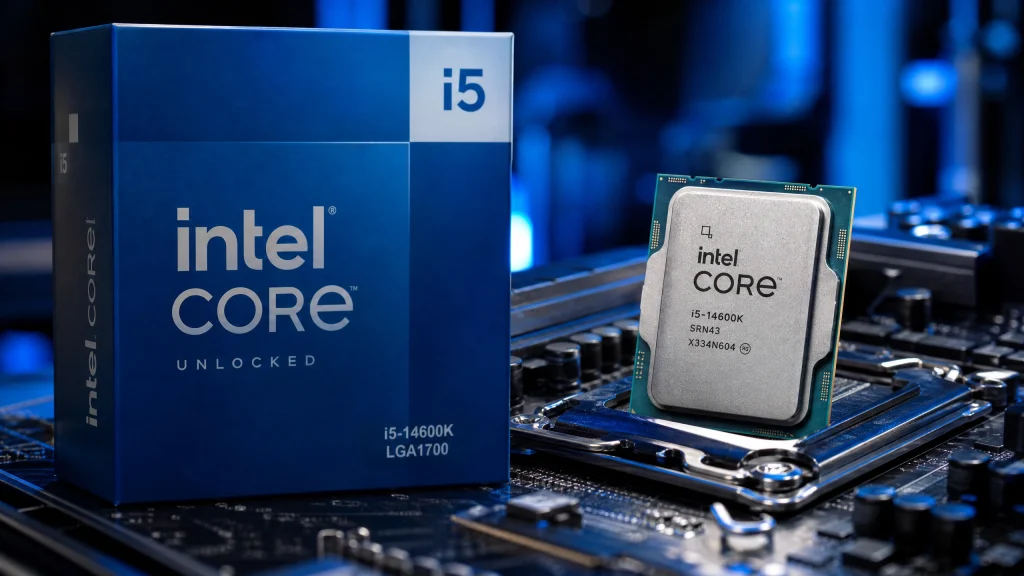
The Intel Core i5-14600K is a 14-core, 20-thread processor that sits at the heart of Intel’s 14th Generation Raptor Lake Refresh lineup. It targets the performance-hungry gamer and part-time content creator who wants the fastest gaming CPU available without stepping up to i7 or i9 pricing. At around $300–$320 at retail, it competes directly with AMD’s Ryzen 5 7600X — and in almost every category that matters to gamers, it comes out ahead. Intel Core i5-14600K
—
### Full Technical Specifications
– **Architecture**: Raptor Lake Refresh (Intel 7 / 10nm ESF process)
– **Core Configuration**: 6 Performance cores (P-cores) + 8 Efficiency cores (E-cores)
– **Total Cores / Threads**: 14 cores / 20 threads
– **P-Core Base Clock**: 3.5 GHz
– **P-Core Boost Clock**: 5.3 GHz
– **E-Core Base Clock**: 2.6 GHz
– **E-Core Boost Clock**: 4.0 GHz
– **L2 Cache**: 20MB
– **L3 Cache**: 24MB
– **TDP (Processor Base Power)**: 125W
– **Maximum Turbo Power (PL2)**: 181W
– **Socket**: LGA1700
– **Memory Support**: DDR4 and DDR5 dual-channel
– **PCIe Lanes**: 5.0 (x16) for primary GPU slot, 4.0 (x4) for M.2 storage
– **Integrated Graphics**: Intel UHD Graphics 770
The “K” suffix confirms an unlocked multiplier for manual overclocking. This CPU requires a Z-series motherboard (Z690 or Z790) to take full advantage of overclocking capabilities, though it operates normally in B760 boards with power limit restrictions.
—
### Gaming Performance: The Core Strength
Single-core clock speed is the most important factor in gaming performance, and the i5-14600K’s 5.3 GHz P-core boost clock gives it an edge over the Ryzen 5 7600X’s 5.3 GHz maximum (though AMD’s frequency tuning varies per-game differently).
**1440p Gaming Benchmarks — RTX 4080 Super, avg fps:**
– **Cyberpunk 2077 (Ultra RT)**: i5-14600K 97 fps | Ryzen 5 7600X 92 fps (+5.4%)
– **Hogwarts Legacy (Ultra)**: i5-14600K 110 fps | Ryzen 5 7600X 105 fps (+4.8%)
– **F1 23 (Ultra High)**: i5-14600K 145 fps | Ryzen 5 7600X 140 fps (+3.6%)
– **Red Dead Redemption 2 (Ultra)**: i5-14600K 118 fps | Ryzen 5 7600X 115 fps (+2.6%)
– **Starfield (Ultra)**: i5-14600K 88 fps | Ryzen 5 7600X 83 fps (+6%)
– **Forza Horizon 5 (Extreme)**: i5-14600K 165 fps | Ryzen 5 7600X 158 fps (+4.4%)
– **Spider-Man Miles Morales (Very High)**: i5-14600K 132 fps | Ryzen 5 7600X 128 fps (+3.1%)
**1080p Gaming Benchmarks (more CPU-sensitive):**
– **Cyberpunk 2077 (Ultra RT, 1080p)**: i5-14600K 115 fps | Ryzen 5 7600X 107 fps (+7.5%)
– **CS2 (Competitive settings)**: i5-14600K 620 fps | Ryzen 5 7600X 580 fps (+6.9%)
– **Valorant (1080p Max)**: i5-14600K 650 fps | Ryzen 5 7600X 600 fps (+8.3%)
– **Fortnite (Competitive, 1080p)**: i5-14600K 380 fps | Ryzen 5 7600X 345 fps (+10.1%)
The i5-14600K consistently leads in gaming across the board. At 1440p and 4K the differences are modest (3–7%), but at 1080p where CPU scheduling matters more, Intel’s advantage grows to 7–10% in the most CPU-bound scenarios. Intel Core i5-14600K
—
### Multi-Core and Productivity Performance
This is where the 14-core configuration decisively separates the i5-14600K from AMD’s 6-core Ryzen 5 7600X.
**Cinebench R23:**
– i5-14600K Multi-Core: ~24,000 points
– i5-14600K Single-Core: ~2,100 points
– Ryzen 5 7600X Multi-Core: ~15,200 points (+58% Intel advantage)
– Ryzen 5 7600X Single-Core: ~2,000 points
**Real-World Application Benchmarks:**
– **Handbrake H.265 Encoding (10 min video)**: Intel Core i5-14600K 3m 20s | Ryzen 5 7600X 5m 10s (~35% faster)
– **Blender 3.6 BMW Benchmark**: i5-14600K 2m 48s | Ryzen 5 7600X 4m 22s (~36% faster)
– **DaVinci Resolve 4K Export**: i5-14600K 4m 05s | Ryzen 5 7600X 6m 20s (~35% faster)
– **Large C++ Project Compilation**: i5-14600K 2m 15s | Ryzen 5 7600X 3m 30s (~36% faster)
– **7-Zip Compression Benchmark**: i5-14600K 87,000 MIPS | Ryzen 5 7600X 55,000 MIPS (~58% faster)
The 8 additional Efficiency cores handle background tasks and parallelizable workloads without compromising the P-core headroom reserved for gaming. The result is a processor that games and creates content simultaneously with less performance degradation than a 6-core alternative. Intel Core i5-14600K
—
### Thermals, Cooling, and Platform Stability
**Cooling Requirements:**
The i5-14600K does not include a stock cooler — a deliberate choice by Intel for unlocked K-series processors. Our tested recommendations:
– **Minimum**: Noctua NH-U12S (single tower air) — adequate for stock settings
– **Recommended**: Noctua NH-D15 or be quiet! Dark Rock Pro 4 (dual tower air)
– **Best**: 240mm AIO liquid cooler for all-core overclocking
With a 240mm AIO under full Cinebench R23 load:
– Average temperature: 88–92°C
– Peak temperature: 95°C (thermal throttle point is 100°C)
Under gaming load (mixed, not all-core sustained):
– Average temperature: 65–76°C, i5-14600K
– Very comfortable for long sessions
**Raptor Lake Stability Notice:**
Intel publicly acknowledged a microcode-related instability issue affecting 13th and 14th Gen Raptor Lake processors in 2024, caused by elevated voltage requests degrading the CPU over time when power limits are unconstrained. Intel released a microcode patch (v0x125) distributed via motherboard BIOS updates. Before using this CPU, update your BIOS to the latest version that includes this patch, and ensure your motherboard applies Intel’s recommended power limit settings (PBP: 125W, MTP: 181W). i5-14600K
—
### Overclocking
With a Z790 board and good cooling:
– **P-Core all-core OC**: 5.5 GHz stable at 1.24–1.27V
– **E-Core OC**: 4.3–4.4 GHz
– **Memory (DDR5)**: DDR5-6000 CL30 easily achievable; DDR5-6400+ possible with good sticks
Overclocking the Intel Core i5-14600K provides moderate additional gaming performance (2–5%) and more meaningful gains in multi-threaded workloads (8–12%). Given the instability concerns with elevated voltages, we recommend modest all-core overclocks with careful validation testing. Intel Core i5-14600K
—
### Platform and Motherboard Choices
The LGA1700 platform supports both DDR4 and DDR5, giving builders flexibility:
**DDR4 Build (Z790 or B760):**
– Total savings vs DDR5 equivalent: ~$100–$150
– B760 boards with DDR4 available from $120
– DDR4-4800 performance is sufficient for all gaming workloads
**DDR5 Build (Z790):**
– Future-proof for DDR5-7200 XMP profiles
– Slightly faster in memory-bandwidth-intensive tasks
– Premium Z790 DDR5 boards from $180–$250
Intel Core i5-14600K
For a gaming-focused build, DDR4 remains entirely appropriate and saves meaningful budget for GPU or cooler upgrades. Intel Core i5-14600K
—
### i5-14600K vs Competing Options Intel Core i5-14600K
| CPU | Gaming Avg | Multi-Core | TDP | Price |
|—|—|—|—|—|
| i5-14600K | 100% (baseline) | 100% | 181W PL2 | $310 |
| Ryzen 5 7600X | -5% | -36% | 105W | $240 |
| i7-14700K | +3% | +18% | 253W PL2 | $420 |
| Ryzen 7 7700X | -2% | -15% | 105W | $340 |
The i5-14600K occupies a uniquely strong position — faster in gaming than any competing AMD mid-range option, and offering far superior multi-threaded performance for productivity at a lower price than the Ryzen 7 7700X.
—
### Verdict
The Intel Core i5-14600K is the definitive mid-range gaming CPU for 2024. It leads AMD’s Ryzen 5 7600X in gaming performance, decisively outpaces it in multi-threaded workloads, and offers DDR4 platform flexibility that keeps total build costs competitive. If you are upgrading from any 8th–11th Gen Intel CPU or AMD Ryzen 2000/3000 series, the performance improvement will be immediately and significantly noticeable in both games and everyday tasks.
**Score: 8.5 / 10** — Best mid-range gaming CPU currently available. link.site
