
Post
NVIDIA RTX 5090 vs AMD Radeon RX 8900 XTX: The Ultimate Flagship Showdown
May
# NVIDIA RTX 5090 vs AMD Radeon RX 8900 XTX: The Ultimate Flagship Showdown
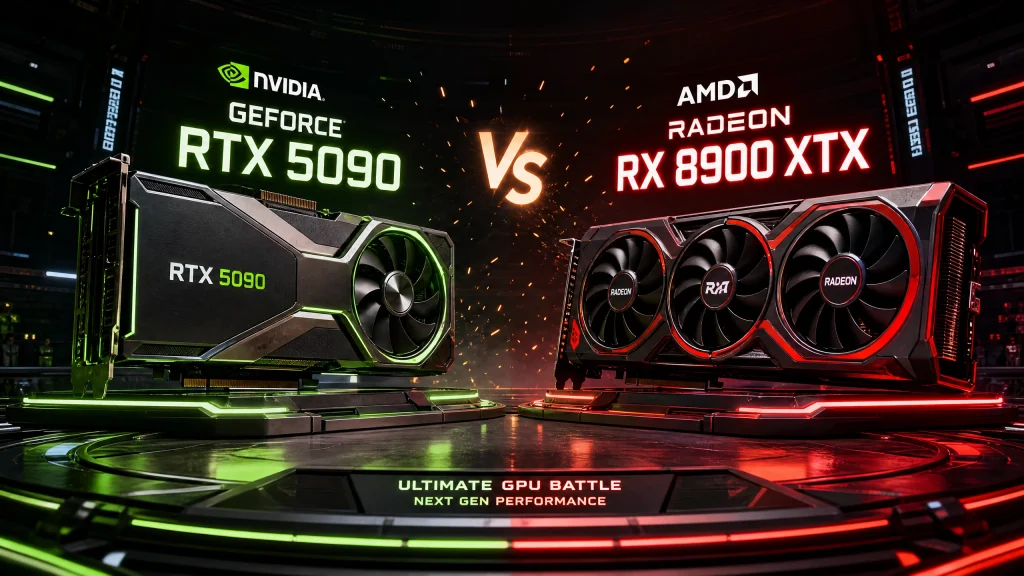
The battle for visual supremacy in the graphics card market has reached an unprecedented peak. Tech enthusiasts, hardcore gamers, and professional creators are witnessing a massive generational leap. On one side stands the green titan with its highly anticipated Blackwell architecture, represented by the monster **NVIDIA GeForce RTX 5090**. On the other side is the red team, pushing chiplet technology to its absolute limit with the RDNA-based **AMD Radeon RX 8900 XTX**. This in-depth comparison will analyze every facet of these flagship graphics cards, including architectural breakthroughs, raw rasterization, ray tracing advancements, AI upscaling, and thermal dynamics to determine which GPU deserves your hard-earned money.
## 1. Architectural Deep Dive: Blackwell vs RDNA Evolution
NVIDIA’s Blackwell architecture introduces massive changes to the consumer space. Built on a customized TSMC node, the RTX 5090 utilizes an ultra-dense monlithic die or an advanced multi-chip module design optimized for massive parallel computing. It boasts a staggering number of CUDA cores, enhanced Fourth-Gen Tensor Cores, and Fifth-Gen RT Cores.
Memory bandwidth sees a major upgrade with the integration of next-generation GDDR7 VRAM operating on a wide bus, delivering over 1.5 TB/s of bandwidth. This allows the card to handle ultra-high resolution textures without breaking a sweat. For more technical specifications on the architecture, visit the official [NVIDIA Website](https://www.nvidia.com).
AMD, conversely, refined its revolutionary chiplet architecture. The Radeon RX 8900 XTX employs an advanced MCD (Memory Cache Die) and GCD (Graphics Compute Die) design fabricated on a combination of cutting-edge TSMC nodes. Featuring thousands of Stream Processors, newly designed ray accelerators, and dedicated AI matrix accelerators, AMD focuses on maximizing compute density and efficiency. The integration of high-density Infinity Cache coupled with rapid GDDR7 memory ensures that the GPU maintains a near-zero latency pipeline. Learn more about their chiplet philosophy directly at the [AMD Official Page](https://www.amd.com).
## 2. Raw Rasterization Performance Benchmarks
When it comes to pure, unadulterated gaming horsepower without ray tracing or upscaling enabled, the competition is incredibly tight. In standard rasterized titles like *Call of Duty: Modern Warfare III*, *Cyberpunk 2077* (with RT off), and *Assassin’s Creed Mirage*, both cards push frame rates well past the 144 FPS threshold at native 4K resolution.
The AMD Radeon RX 8900 XTX showcases immense strength in traditional rendering. Thanks to its high clock speeds and massive compute units, it frequently matches or slightly edges out the RTX 5090 in specific DX12 and Vulkan-based titles. The structural efficiency of AMD’s design means that at native 4K, games experience flawless frame pacing and minimal micro-stuttering. Benchmarks from trusted hardware reviewers like [Tom’s Hardware](https://www.tomshardware.com) confirm that for traditional gaming, AMD offers jaw-dropping rasterization performance per dollar.
NVIDIA’s RTX 5090, however, establishes dominance when workloads become heavily geometry-bound or utilize complex mesh shading algorithms. The raw throughput of its massive CUDA array ensures that even at native 8K resolution testing, the RTX 5090 maintains an exceptionally stable frame rate. It provides an elite tier of performance that ensures long-term viability for upcoming next-generation game engines.
## 3. Ray Tracing and Path Tracing Supremacy
While rasterization is highly competitive, ray tracing and full path tracing tell a completely different story. Path tracing simulates the physical behavior of light with pinpoint accuracy, creating heavy computational demands. This is where NVIDIA’s multi-generational investment in hardware-accelerated ray tracing pays off.
The RTX 5090 utilizes its Fifth-Generation RT Cores to execute real-time bounding volume hierarchy (BVH) traversals efficiently. In titles featuring heavy path tracing, such as *Alan Wake 2* and *Cyberpunk 2077 Overdrive Mode*, the RTX 5090 runs circles around the competition. It delivers playable frame rates at native resolutions that were previously thought impossible. The specialized hardware handles ray sorting, opacity micromaps, and displaced micro-meshes flawlessly, mitigating the traditional performance penalties associated with realistic reflections and global illumination.
AMD has made significant strides with the RX 8900 XTX, integrating upgraded Ray Accelerators that handle intersecting rays much more efficiently than prior generations. In standard ray-traced games where the effects are limited to shadows and basic reflections, the RX 8900 XTX performs admirably, offering a smooth 64-80 FPS at 4K. However, when pushed to full path tracing, the chiplet architecture experiences a bottleneck, requiring heavy reliance on upscaling techniques to maintain smooth gameplay. For detailed architectural breakdowns of these ray-tracing pipelines, consult resources on [TechPowerUp](https://www.techpowerup.com).
## 4. The Battle of AI Upscaling: DLSS 4.0 vs FSR 4.0
In modern gaming, hardware power is only half the equation; the rest relies on intelligent software and neural reconstruction. NVIDIA introduces DLSS 4.0 (Deep Learning Super Sampling), which leverages the Blackwell Tensor Cores to execute advanced multi-frame generation, neural rendering, and AI-driven ray reconstruction simultaneously. DLSS 4.0 reconstructs lower-resolution inputs into crystal-clear 4K or 8K outputs with virtually zero visual artifacts, often looking sharper than native rendering due to advanced anti-aliasing models.
AMD counters with FSR 4.0 (FidelityFX Super Resolution), which marks a massive departure from their previous spatial upscalers. FSR 4.0 fully embraces machine learning algorithms, utilizing the dedicated AI accelerators on the RX 8900 XTX. This shift brings FSR’s image quality and temporal stability remarkably close to NVIDIA’s solution, eliminating the edge shimmering and ghosting that plagued older versions. Because FSR remains part of an open-source initiative, it enjoys widespread adoption across a variety of hardware platforms. You can trace the performance evaluations of these technologies on gaming portals like [PC Gamer](https://www.pcgamer.com).
## 5. Power Consumption, Thermals, and Board Design
Pumping out this level of graphical power requires substantial electrical energy and robust thermal management systems. The RTX 5090 features a substantial Total Board Power (TBP) rating, requiring a high-quality PCIe 5.0 12V-2×6 power connector. Founders Edition and aftermarket models utilize massive triple-slot cooling configurations with dual-axial fans, vapor chambers, and premium thermal pads to keep the Blackwell GPU under 70°C under full load. Users must ensure their PC cases possess adequate clearance and their power supplies are rated for at least 1000W to avoid system instability.
AMD’s Radeon RX 8900 XTX prioritizes a slightly more conventional and user-friendly power configuration. While it still draws significant wattage, its power distribution is handled via refined multi-pin connectors that mitigate the melting risks associated with older adapter designs. The chiplet layout spreads heat across multiple dies, allowing massive custom triple-fan coolers to dissipate thermal energy effectively. It operates with lower noise levels in standard configurations, making it a highly attractive option for builders who favor quiet operating environments.
## 6. Pricing, Availability, and Final Buying Verdict
Pricing plays a crucial role in determining the true winner of this flagship duel. NVIDIA positions the RTX 5090 as an ultra-premium enthusiast product, carrying a premium price tag that reflects its unmatched ray tracing and AI dominance. It targets professionals, content creators, and gamers who refuse to compromise on visual fidelity.
AMD continues its aggressive value-oriented strategy with the RX 8900 XTX. By undercutting NVIDIA’s pricing significantly while delivering matching or superior traditional rasterization performance, AMD presents an incredibly compelling package for the vast majority of core gamers.
**Final Verdict:** If you demand absolute performance supremacy, spend your time in path-traced worlds, or require top-tier AI compute for machine learning and professional 3D rendering workloads, the **NVIDIA GeForce RTX 5090** is the undisputed champion. However, if you are looking for exceptional 4K gaming performance, prefer open-source software ecosystems, and want to save hundreds of dollars without sacrificing raw rasterization speed, the **AMD Radeon RX 8900 XTX** is the smartest choice for high-end builders.
The FAQ addresses three key points: First, it is advised to use an ATX 3.0 or ATX 3.1 power supply with a native PCIe 5.0 cable for the RTX 5090 to ensure stable power delivery. Second, AMD FSR 4.0 is compatible with NVIDIA graphics cards but performs best on hardware with AI matrix cores. Finally, NVIDIA is generally preferred for video editing and content creation due to better optimization in software like Adobe Premiere Pro and DaVinci Resolve, although AMD’s large VRAM offers strong competition.
