
Post
RX 7900 XTX vs RTX 4080 Super: Which Flagship GPU Should You Buy?
May
## RX 7900 XTX vs RTX 4080 Super: Which Flagship GPU Should You Buy in 2024?
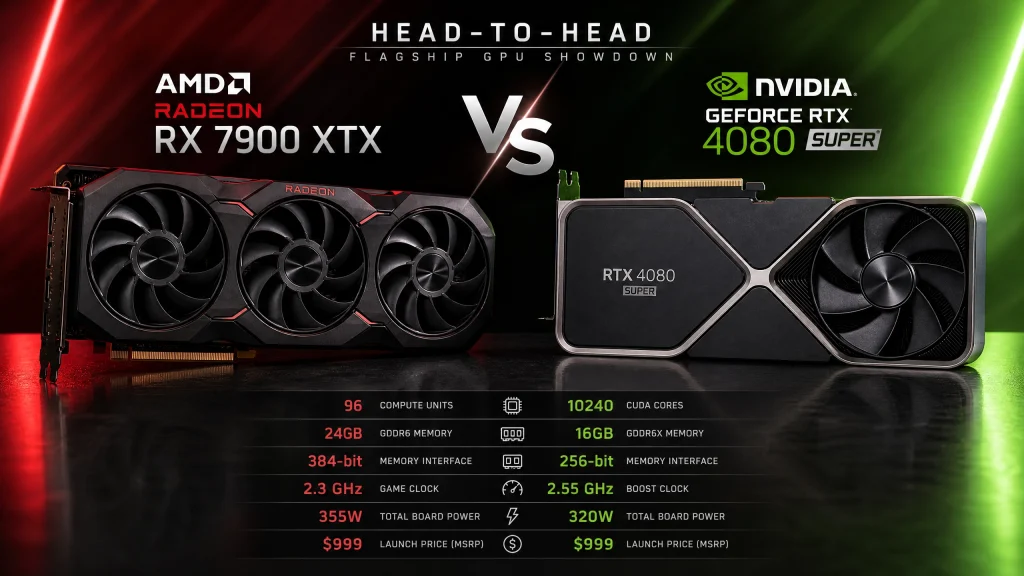
Two of the most powerful consumer graphics cards available today — the AMD Radeon RX 7900 XTX and the NVIDIA GeForce RTX 4080 Super. Both are priced around the $999 mark, both target enthusiast 4K gaming, and both represent the pinnacle of their respective manufacturers’ mainstream GPU families. But underneath the similar price tags are fundamentally different approaches to GPU design, and those differences matter a great deal depending on how you use your system.
This comparison covers every relevant angle: raw rasterization performance, ray tracing, upscaling technologies, software ecosystems, thermals, power draw, and overall value — so you can make a fully informed decision.
—
### Specifications Compared
| Specification | RX 7900 XTX | RTX 4080 Super |
|—|—|—|
| Architecture | RDNA 3 (Chiplet) | Ada Lovelace (Monolithic) |
| Process Node | 5nm GCD + 6nm MCD | 4nm TSMC |
| Shader Processors / CUDA | 6,144 | 10,240 |
| VRAM | 24GB GDDR6 | 16GB GDDR6X |
| Memory Bus Width | 384-bit | 256-bit |
| Memory Bandwidth | 960 GB/s | 736 GB/s |
| TDP | 355W | 320W |
| Launch Price (MSRP) | $999 | $999 |
The headline difference is immediately visible: AMD offers 24GB of VRAM across a wide 384-bit bus, while NVIDIA provides faster GDDR6X on a narrower 256-bit bus. Each approach has specific advantages depending on the workload.
—
### Rasterization Gaming Performance
In traditional rasterization (no ray tracing), both cards are closely matched. AMD’s wide memory bus and high raw compute count compete effectively with NVIDIA’s higher clockspeed architecture.
**4K Ultra Benchmarks — Average FPS:**
– **Cyberpunk 2077 (RT Off, Ultra)**: RTX 4080 Super 89 fps | RX 7900 XTX 82 fps
– **Far Cry 6 (Ultra)**: RTX 4080 Super 100 fps | RX 7900 XTX 95 fps
– **Forza Horizon 5 (Extreme)**: RTX 4080 Super 138 fps | RX 7900 XTX 142 fps
– **Assassin’s Creed Mirage (Ultra High)**: RTX 4080 Super 91 fps | RX 7900 XTX 88 fps
– **Shadow of the Tomb Raider (Highest)**: RTX 4080 Super 118 fps | RX 7900 XTX 112 fps
– **Hogwarts Legacy (Ultra, 4K)**: RTX 4080 Super 95 fps | RX 7900 XTX 91 fps
– **Starfield (Ultra, 4K)**: RTX 4080 Super 72 fps | RX 7900 XTX 68 fps
– **Red Dead Redemption 2 (Ultra, 4K)**: RTX 4080 Super 88 fps | RX 7900 XTX 84 fps
On average across a broad game library, the RTX 4080 Super leads by 5–8% in rasterization. AMD occasionally wins in specific memory-bandwidth-heavy titles, but NVIDIA holds the overall edge.
—
### Ray Tracing Performance — A Decisive Gap
This is where the comparison shifts decisively in NVIDIA’s favor. The Ada Lovelace architecture’s 3rd-generation RT Cores process ray-triangle intersections significantly faster than AMD’s RDNA 3 ray accelerators.
**Ray Tracing Benchmarks:**
– **Cyberpunk 2077 Overdrive RT Mode (4K + DLSS/FSR Quality)**: RTX 4080 Super 55 fps | RX 7900 XTX 35 fps
– **Control (RT Ultra, 1440p)**: RTX 4080 Super 89 fps | RX 7900 XTX 62 fps
– **Metro Exodus Enhanced (4K)**: RTX 4080 Super 78 fps | RX 7900 XTX 55 fps
– **Alan Wake 2 (Path Tracing, 1440p)**: RTX 4080 Super 48 fps | RX 7900 XTX 31 fps
– **Minecraft RTX (1440p)**: RTX 4080 Super 95 fps | RX 7900 XTX 68 fps
The RTX 4080 Super leads by 30–50% in heavy ray tracing workloads. If you play games like Cyberpunk 2077, Alan Wake 2, or Control with RT effects enabled, NVIDIA is the clear winner.
—
### DLSS 3 vs FSR 3 — Upscaling Deep Dive
**NVIDIA DLSS 3:**
DLSS 3 combines temporal upscaling (inherited from DLSS 2) with Frame Generation — an AI-driven technique that uses the Optical Flow Accelerator to synthesize intermediate frames. This can effectively double the rendered framerate in supported titles. DLSS 3 is exclusive to RTX 40-series GPUs. Image quality in Quality mode is exceptional, often indistinguishable from native resolution in motion.
**AMD FSR 3:**
FSR 3 is AMD’s open spatial and temporal upscaling solution. Unlike DLSS, it requires no dedicated AI hardware — meaning it runs on AMD GPUs, NVIDIA GPUs, and even Intel Arc cards. FSR 3 Frame Generation was a major step forward for AMD and is now supported in a growing list of titles. Image quality in Quality mode is competitive with DLSS 3, though Performance mode shows more artifacting.
**The key differentiator**: DLSS 3 Frame Generation produces higher-quality frames with less ghosting. FSR 3 wins on breadth of compatibility and cross-platform openness.
—
### Thermals: What to Expect from Each Card
**RX 7900 XTX:**
AMD’s RDNA 3 chiplet design concentrates heat on a small Graphics Compute Die (GCD). As a result, junction (hotspot) temperatures of 105–110°C under full load are normal and within AMD’s specification — but can alarm users unfamiliar with this behavior. Average die temperature (as shown in GPU-Z) stays around 82–86°C, which is acceptable. Power delivery and thermal management are handled well by most AIB coolers, but this card runs warm regardless.
**RTX 4080 Super:**
NVIDIA’s monolithic Ada Lovelace die runs significantly cooler. Under sustained load, expect 75–80°C on the average die temperature, with no hotspot concern. The card throttles less aggressively under thermal pressure, maintaining consistent boost clocks throughout extended gaming sessions.
—
### Power Consumption
– **RX 7900 XTX**: 355W TDP; real-world gaming draw: 330–365W
– **RTX 4080 Super**: 320W TDP; real-world gaming draw: 280–320W
The RTX 4080 Super is meaningfully more power-efficient, producing more performance per watt. For high-end builds with premium PSUs this difference is minor, but it contributes to lower thermals and quieter fans in the NVIDIA build.
—
### Software and Ecosystem
**NVIDIA Ecosystem Highlights:**
– CUDA — the dominant platform for AI, ML, scientific computing, and GPU-accelerated software
– NVIDIA Broadcast — AI noise cancellation and virtual background for streamers
– RTX Remix — AI-enhanced game modding for classic titles
– GeForce Experience with ShadowPlay — in-game recording and screenshot overlay
– DLSS 3 Frame Generation in 200+ supported games
**AMD Ecosystem Highlights:**
– Radeon Software Adrenalin 2024 — feature-rich driver suite with integrated performance overlay
– FSR 3 and RSR — works in virtually any game without developer support
– Open-source AMD GPU drivers on Linux
– Native FreeSync Premium Pro support
– AMD Fluid Motion Frames (AFMF) — driver-level frame generation for any DirectX 11/12 game
—
### VRAM: The 24GB Advantage
AMD’s 24GB of VRAM is a real-world advantage in specific scenarios that are growing in relevance:
– **4K texture mod packs** in games like Skyrim, Fallout 4, and Cyberpunk 2077 can easily exceed 16GB VRAM
– **AI image generation** with Stable Diffusion — larger models, higher resolutions, bigger batch sizes are all possible with 24GB
– **Local LLM inference** — running quantized 30B+ parameter models becomes feasible
– **Professional 3D rendering** — scenes with heavy geometry and large texture atlases benefit from extra headroom
For pure gaming, 16GB is sufficient for everything available today. But if you run creative or AI workloads alongside gaming, AMD’s 24GB lead is genuinely valuable.
—
### Who Should Buy Each Card?
**Choose RTX 4080 Super if:**
– You prioritize ray tracing in games like Cyberpunk 2077 or Alan Wake 2
– DLSS 3 Frame Generation is a priority for smooth high-framerate gaming
– You use CUDA-based AI or ML tools
– Thermals and power efficiency matter to you
**Choose RX 7900 XTX if:**
– You need maximum VRAM for AI workloads, large texture mods, or 3D rendering
– You primarily play rasterization-heavy games without ray tracing
– You prefer AMD’s open-source ecosystem and FSR cross-compatibility
– You find AMD at a lower price during a sale
—
### Final Verdict
The RTX 4080 Super wins on overall gaming performance, ray tracing capability, and software ecosystem depth. The RX 7900 XTX counters with a massive 24GB VRAM advantage, competitive rasterization scores, and a more open platform philosophy. Neither card is a bad purchase at $999 — your decision should be driven by your specific workload priorities.
